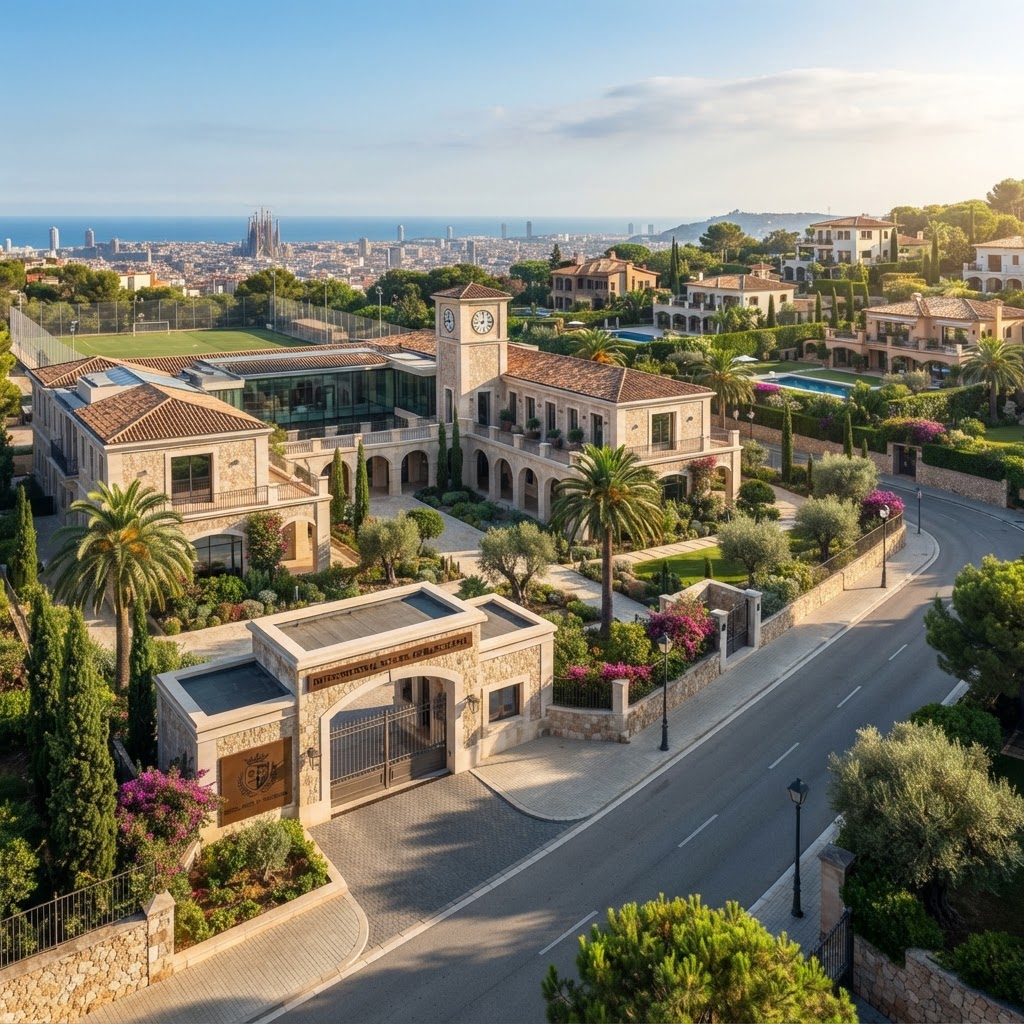
The Eixample is Barcelona's grand modernist district — a grid of wide avenues and chamfered corners that holds the city's finest collection of period apartments, noble floors and terrace penthouses. For the international buyer seeking architectural character at the heart of the city, no other neighborhood offers the same combination of heritage, walkability and prestige. This guide, written from the perspective of a private buyer's advisor, covers everything you need to know about acquiring luxury property in Eixample — from noble floors and penthouses to pricing, the buying process, and off-market access.
The Grand Modernist District
Designed by Ildefons Cerdà in the mid-19th century, the Eixample was conceived as a rational grid of wide streets, sunlit blocks and interior courtyards. What began as an urban-planning experiment became, within a generation, the canvas for Catalonia's architectural golden age. Antoni Gaudí, Lluís Domènech i Montaner and Josep Puig i Cadafalch filled the district with their modernist masterpieces — Casa Batlló, Casa Milà, Casa Amatller, the Palau de la Música — many of which are now UNESCO World Heritage Sites.
For the luxury buyer, the Eixample's appeal lies not only in its architecture but in its centrality. Passeig de Gràcia, the district's grand boulevard, is Barcelona's premier luxury shopping street, home to Chanel, Hermès, Louis Vuitton and Rolex. The finest restaurants, hotels and cultural institutions are within walking distance. And the apartments behind those ornate modernist façades are among the most desirable in Spain.
Location & Access
Noble Floors & Pisos Principales
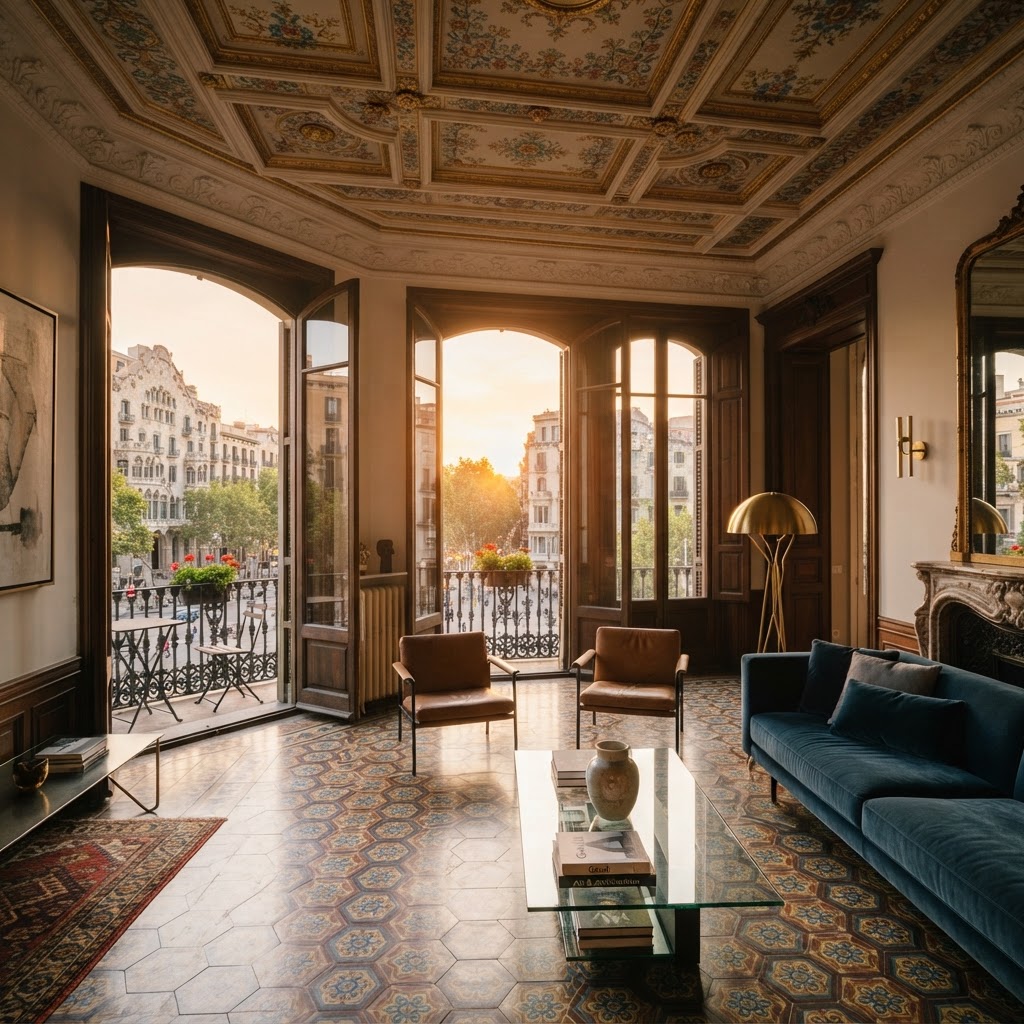
The pis principal, or noble floor, is the jewel of Eixample real estate. In the grandest buildings — those constructed between 1880 and 1930 for Barcelona's wealthiest families — the principal floor sits one level above the ground, accessed by a monumental staircase (and today, discreetly, by a private lift). These apartments were designed for entertaining: reception rooms of 60 m² or more, ceiling heights of 3.5 to 4.2 metres, and floor-to-ceiling windows opening onto balconies overlooking the street.
Original modernist details are what set these properties apart: coffered ceilings with floral motifs, hydraulic tile floors in geometric patterns, wrought-iron balconies, stained-glass skylights, carved wooden doors and marble fireplaces. A well-preserved noble floor in a building on Passeig de Gràcia or Casp can feel less like an apartment and more like a private museum.
Restoration is the key consideration. Many noble floors have been subdivided over the decades and need to be returned to their original layout. Others retain their details but require complete upgrading of electrical, plumbing and climate systems. Catalan heritage regulations protect many Eixample buildings; façades, staircases and original interior elements may be listed, meaning restoration must be carried out by specialised artisans and approved by the local heritage authority. A buyer's agent with experience in modernist restoration is essential — the difference between a sensitive restoration and a botched renovation is measured in millions.
The pricing premium for a well-restored noble floor is significant. These properties command a substantial uplift per square metre compared to standard apartments in the same building — a premium that reflects both their rarity and the cost of authentic restoration.
Penthouses & Áticos
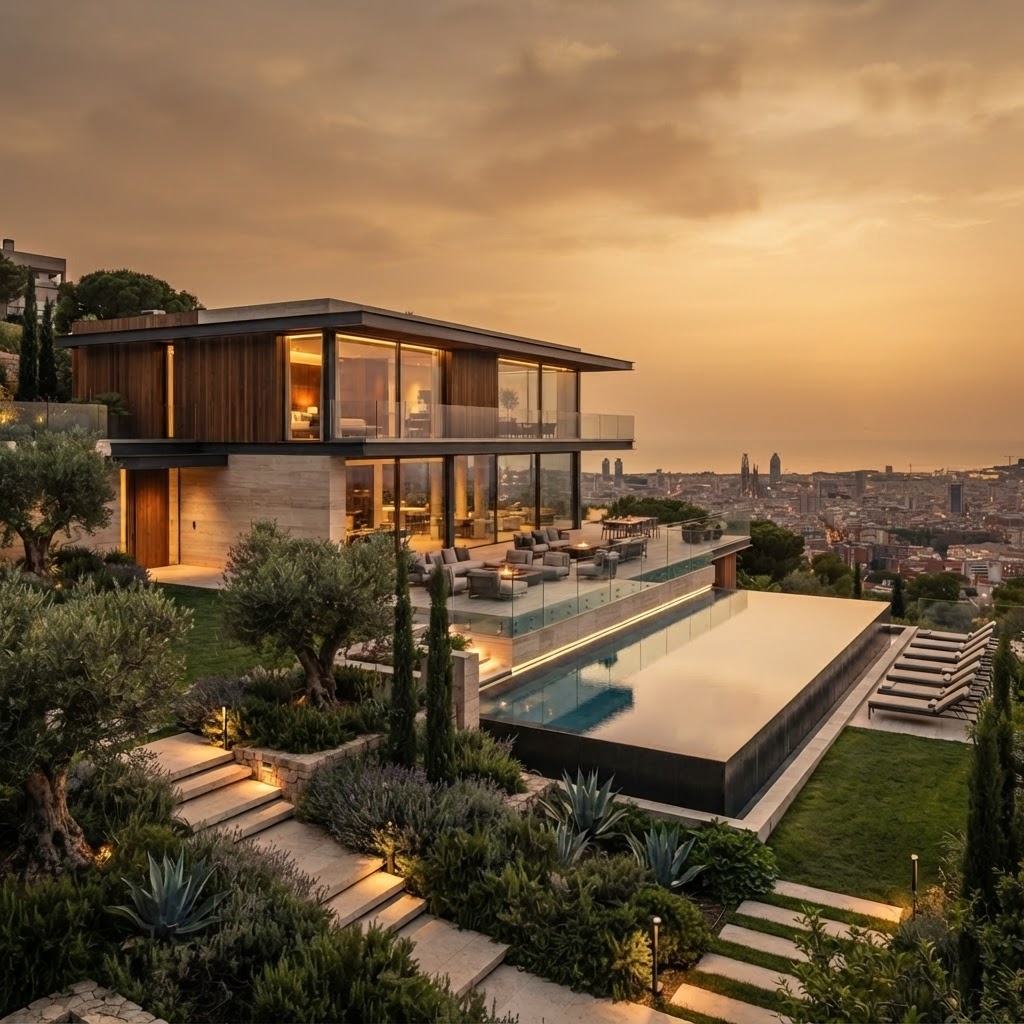
At the top of the Eixample's grandest buildings, áticos (penthouses) offer a different proposition: light, air and panoramic views. A true Eixample penthouse features a large private terrace — sometimes wrapping around the building — with unobstructed sightlines over the city's grid. From a top-floor apartment on Passeig de Gràcia, the view sweeps toward the Sagrada Família; from the Dreta's upper reaches, the Tibidabo and Collserola mountains frame the skyline.
The best penthouses combine period character with contemporary architecture: original beams and high ceilings below, with a modern glass-and-steel extension above opening onto the terrace. Infinity pools, outdoor kitchens and landscaped roof gardens are increasingly common in the most ambitious projects. These properties are extraordinarily rare — a building may have only one or two — and almost never appear on public portals.
Pricing for penthouses reflects their scarcity. A terrace penthouse on Passeig de Gràcia or in the golden quadrant of the Dreta can command the highest price per square metre in the Eixample, often exceeding the noble-floor premium.
Eixample penthouses pair modernist heritage with contemporary terrace living.
Free Guide
The 2026 Barcelona Luxury Buyer's Guide
Process, fees, timelines & off-market access
Indicative Pricing
Indicative price range for luxury apartments in Eixample Dreta: €5,500–€8,000/m². Noble floors and penthouses with terraces command the upper end of this range and beyond, with exceptional properties on Passeig de Gràcia reaching significantly higher. Actual transaction prices — particularly for off-market properties — may vary from published portals.
Eixample Dreta vs Esquerra
The Eixample is divided by the Passeig de Gràcia into two halves: the Dreta (right, or east) and the Esquerra (left, or west). The Dreta is the grander of the two — this is where the most spectacular modernist buildings, the noblest apartments and the highest prices are concentrated. Passeig de Gràcia itself, the Rambla de Catalunya, and the streets of the golden quadrant (Casp, Mallorca, Provença) form the apex of Eixample luxury.
The Esquerra, while less monumental, offers excellent value and a more residential atmosphere. Its streets are lined with well-built early-20th-century buildings, many with attractive apartments that have been sensitively modernised. For buyers who want Eixample centrality at a more accessible price point — or who prefer a quieter, less tourist-heavy environment — the Esquerra is an attractive alternative. The Sant Antoni sub-district, at the Esquerra's southern edge, has emerged as one of Barcelona's most desirable emerging markets, with renovated apartments in classic buildings attracting young international buyers.
Buying Process for Foreign Buyers
International buyers purchasing property in Spain must first obtain an NIE (Número de Identidad de Extranjero), a foreigner identification number required for all financial and legal transactions. A Spanish bank account is also essential for payments, utilities and tax obligations. We recommend engaging a local real estate lawyer — independent of the seller — to conduct full due diligence: title verification, outstanding debts, building certificates and community-of-owners status.
In Catalonia, the primary purchase tax on resale properties is the ITP (Impuesto de Transmisiones Patrimoniales), approximately 10% of the purchase price, with progressive rates that can reach ~13% on amounts above €1.5 million. For new-build properties, IVA (VAT) at 10% applies, plus AJD (Actos Jurídicos Documentados) at approximately 1.5%. Notary fees and land registry fees add a further 1–2%. Total acquisition costs typically amount to 12–14% above the purchase price.
Ongoing costs include the IBI (annual municipal property tax), community-of-owners fees (for building maintenance), and — for non-residents — potential Wealth Tax and Non-Residents' Income Tax (IRNR). A Spanish tax advisor can help structure ownership optimally.
Off-Market Access & Our Advisory Role
The finest Eixample apartments — the noble floors with original details, the penthouses with terraces — are almost never listed publicly. They circulate within a private network of owners, lawyers, notaries and trusted advisors. For the international buyer, accessing these properties requires an agent who is integrated into that network and who works exclusively on your behalf.
As an independent buyer's agent, our role is to represent your interests throughout the entire process. We source off-market opportunities, assess true market value, negotiate without conflict of interest (we never represent the seller), coordinate legal and technical due diligence, and manage the acquisition from first viewing to notary signing. If you are considering a restoration, we can also connect you with the specialised architects and artisans who understand modernist heritage. Our objective is simple: to ensure you acquire the right property at the right price, with total discretion.
Aspect
Key Details
Indicative pricing
€5,500–€8,000/m² for luxury apartments; penthouses and noble floors higher
Top addresses
Passeig de Gràcia, Rambla de Catalunya, Casp, Mallorca — Eixample Dreta golden quadrant
Purchase taxes
ITP ~10% (progressive to ~13% above €1.5M); IVA 10% + AJD ~1.5% for new builds
Total acquisition costs
Typically 12–14% above purchase price
Heritage considerations
Many buildings listed; restoration requires specialised artisans and heritage approval
Advisory
Independent buyer's agent for off-market access and conflict-free negotiation
Indicative pricing
Key Details€5,500–€8,000/m² for luxury apartments; penthouses and noble floors higher
Top addresses
Key DetailsPasseig de Gràcia, Rambla de Catalunya, Casp, Mallorca — Eixample Dreta golden quadrant
Purchase taxes
Key DetailsITP ~10% (progressive to ~13% above €1.5M); IVA 10% + AJD ~1.5% for new builds
Key DetailsIndependent buyer's agent for off-market access and conflict-free negotiation
Frequently Asked Questions
Share this article
About the Author
Myriam Lahlou
Founder & Buyer's Agent, Barcelo Property Invest
Myriam Lahlou is the founder of Barcelo Property Invest, an independent buyer's agency representing international clients purchasing property in Barcelona and the surrounding coastal markets. With 20+ years of international real estate experience between Miami and Barcelona, Myriam combines an international perspective with deep knowledge of the Barcelona property market. Barcelo Property Invest represents buyers exclusively, never sellers, and coordinates each acquisition from the initial search through to completion at the notary.
Private Consultation
Request a Private Consultation
Speak directly with Myriam, our independent buyer's agent. A 30-minute private call to discuss your search, answer your questions and explore how we could support your property acquisition in Barcelona.
Tell us what you're looking for and we'll search the wider Barcelona market on your behalf, including off-market and pre-market opportunities where available.
Stay Informed
Get Barcelona luxury property insights, market updates and selected opportunities delivered to your inbox.