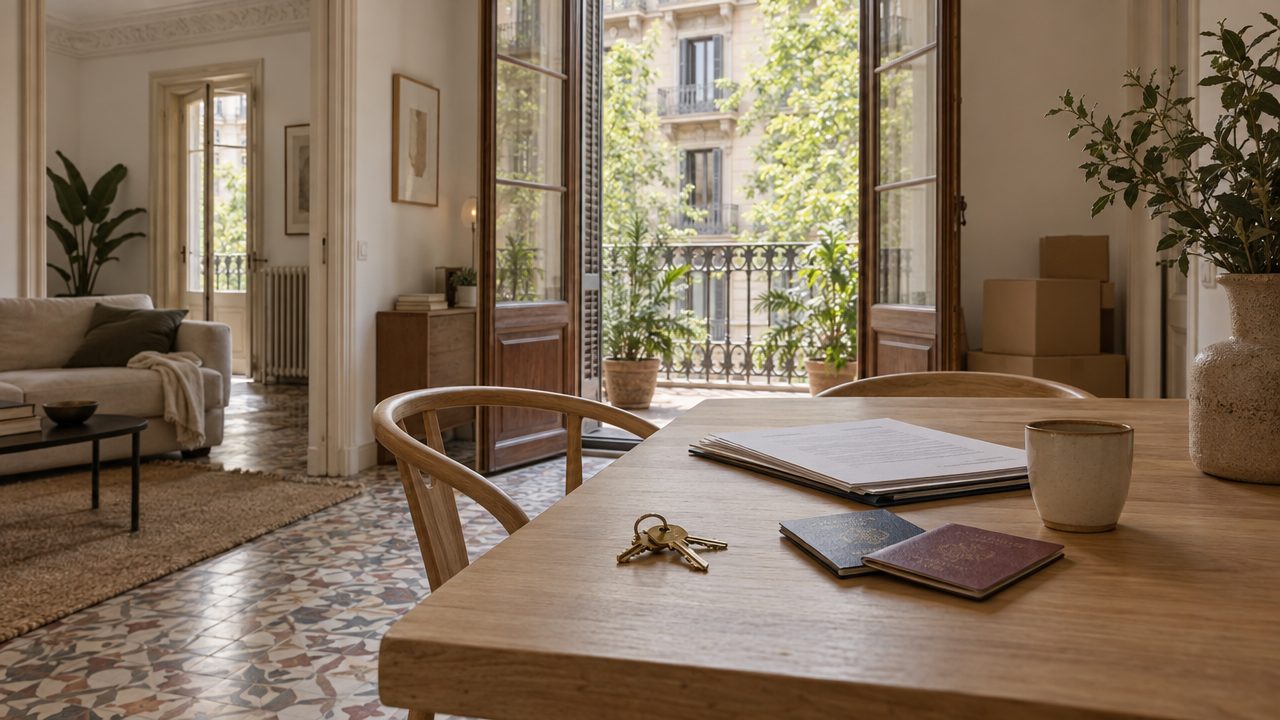
At Barcelo Property Invest, Myriam Lahlou assists international buyers throughout their property acquisition in Barcelona, Sitges, and the Maresme. To clarify some of the most common questions about buying a home and moving to Spain, we invited immigration lawyer Lucía Lagunas Reyes to share her expertise.
Lucía Lagunas Reyes is a Spanish immigration lawyer at My Spain Visa. She prepared the answers below exclusively for Barcelo Property Invest.
1. Does buying a home in Barcelona give me residency in Spain?
No. Owning a flat in Barcelona gives you a set of keys and a yearly tax bill, not the right to live here. With a US or UK passport you can stay 90 days in any 180, like any other visitor, whatever the property cost. The investor visa that was linked to buying property closed to new applicants on 3 April 2025, so a purchase is no longer a route to residency at any price. People who already hold one can still renew it.
To spend more than three months a year in your new home, you need a residence visa, and the right one depends on how you will live. The property still helps, though. A title deed is about the best proof of accommodation you can give a consulate. If you want the full picture, we compare every route to Spanish residency in one place.
2. Which visa fits me if I'm retiring, working remotely or moving with my family?
If you will live on a pension, savings or investments and not work, it is the non-lucrative visa. For 2026 you need €2,400 a month (€28,800 a year) for yourself, plus €600 a month for each family member. It allows no work at all, not even for clients abroad.
Still working for a company or clients outside Spain? Then the digital nomad visa fits better. The 2026 threshold is €2,850 a month gross, plus about €1,068 for the first family member and €356 for each one after that.
Both visas let your spouse or partner and your children under 18 come with you. If one of you holds an EU passport, the non-EU partner can usually skip both and apply for a family member residence card, which is often the simpler path. You can check your own figures against the non-lucrative visa income test.
3. Can I buy before I have the visa, and what do I need first?
Yes. Nothing stops you buying as a visitor, and plenty of buyers sign before they apply. You need three things in place.
• A NIE. This is your foreigner identity number, and no notary will sign the deed without it. You can get your NIE at a Spanish consulate at home or at a police station in Spain.
• A Spanish bank account. The notary checks where the money comes from, and paying the deposit, taxes and bills is far easier from a local account.
• A power of attorney, if you cannot fly in for the signing. Sign it at a Spanish consulate, or before a local notary with an apostille and, usually, a sworn translation.
One warning for retirees. If the purchase eats most of your savings, your bank statements may no longer reach the non-lucrative visa figure. Work out the visa numbers before you decide how much to put into the flat.
4. How long does the visa take, and when can I move in?
You can move in the day you get the keys. Staying longer than 90 days is what needs the visa.
The consulate's part is quicker than most people fear. In our own cases decided between January 2025 and October 2026, Spanish consulates took a median of 44 days from handing in the application to the decision. London took 37 days and Manchester 82, while US consulates came in at a median of 37. Source: My Spain Visa case files, October 2026.
The slow part is the paperwork before the appointment: criminal record checks, apostilles and translations. From the day clients hired us to the day they had the visa, the median was 133 days, so allow four to five months. On the non-lucrative visa, you then have one month from entering Spain to apply for your residence card (TIE). Our report has the waiting times at each consulate.
5. Do I become tax resident once I live in my new home?
Owning the home does not make you tax resident. Time does. Spain treats you as resident if you spend more than 183 days here in a calendar year or your main economic interests are here, and presumes it when your spouse and minor children live here. From then on Spain taxes your worldwide income, and assets abroad worth more than €50,000 in each category have to be declared.
Barcelona adds Catalonia's wealth tax, with an allowance of €500,000 per person plus up to €300,000 for your main home. Until you are resident, you pay non-resident tax on the flat every year, even if you never rent it out.
Tax treaties with the US and the UK stop the same income being taxed twice, and employees on the digital nomad visa who were not tax resident here in the previous five years may qualify for a flat 24% rate on work income up to €600,000. Our tax team can check this before you move.
These are the rules and figures for 2026, and every case has its own details. If you would like us to look at your numbers before you sign, our team at My Spain Visa is happy to help.