How is Barcelona's luxury property market performing in 2026?
Barcelona's luxury market remains resilient in 2026, with prime prices in the Zona Alta holding at €5,000–€9,000/m² and international buyers representing over 40% of prime transactions. Germany and the United States each account for approximately 13% of foreign purchases, France 11%, and China 10% — reflecting Barcelona's broad international appeal. The 2025 Golden Visa abolition has reduced investor-driven demand but created more balanced conditions for genuine lifestyle buyers. The outlook is stable, with selective capital appreciation in the most prestigious neighbourhoods.
Key Facts
Prime price: €5,000–9,000/m²
Foreign buyer share: ~40%+ of prime transactions
Top foreign nationalities: Germany & US ~13% each, France ~11%, China ~10%
Golden Visa abolished: April 2025
Tourist licences: phasing out by 2028 (Barcelona city)
Yields: 3.5–5% gross (indicative)
Figures indicative/sourced
Barcelona's luxury property market enters 2026 in a state of measured resilience. The abolition of the Golden Visa in April 2025 removed one driver of investor demand, and the ongoing phase-out of tourist rental licences by 2028 is reshaping the rental economics. Yet the fundamentals — limited supply in the Zona Alta, broad international demand, and a Mediterranean lifestyle that remains globally competitive on price — continue to support stable values. This report synthesises the key data points international buyers need to understand the market in 2026.
All figures are indicative, compiled from public market sources (including Spain's Colegio de Registradores and leading property portals), and provided for educational purposes only. Nationality share figures are approximate and sourced from Spanish property registry data. Always confirm with current, verified data. Last updated 2026.
What Are Prime Prices by District in 2026?
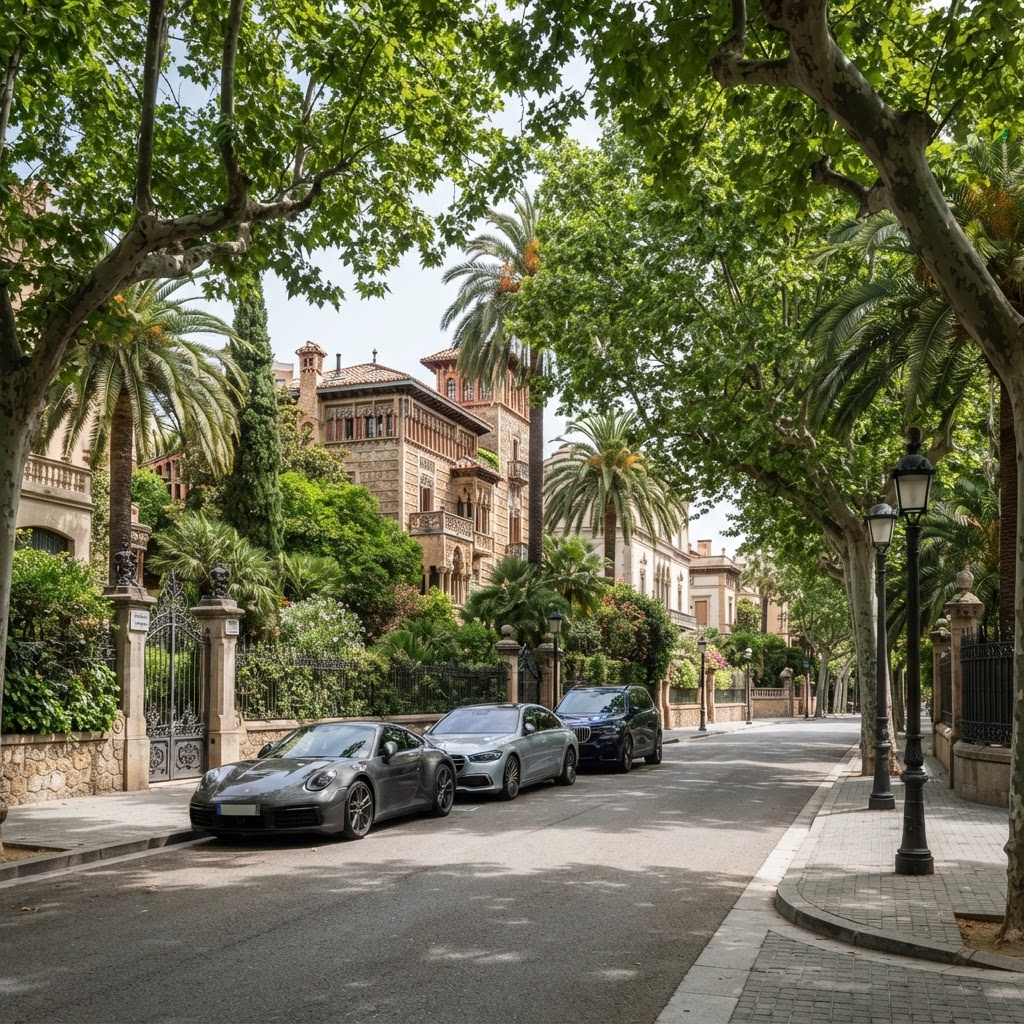
Barcelona's luxury market is concentrated in the Zona Alta and select central districts. The table below shows indicative prime price ranges by district, based on 2025–2026 market data.
Note: Prices are indicative orientation markers based on portal and registry data. Off-market transaction prices may differ. The very top of the market — historic estates on Avenida Tibidabo and bespoke architectural villas in Pedralbes — can exceed €10,000/m², but these are exceptionally rare and almost always transact privately.
Who Is Buying? Foreign-Buyer Share by Nationality
International buyers represent over 40% of prime luxury transactions in Barcelona — one of the highest shares among major European cities. The table below shows the approximate share of foreign purchases by nationality, based on Spanish property registry data.
Nationality
Approx. Share of Foreign Purchases
Typical Buyer Profile
Germany
~13%
Lifestyle buyers, retirees, Zona Alta families
United States
~13%
Executives, digital nomads, tech professionals
France
~11%
Families, second-home buyers, Lycée Français community
Typical Buyer ProfileDiverse European and international buyers
Note: Nationality share figures are approximate, sourced from Spain's Colegio de Registradores and property market reports, and must be confirmed with current registry data. Shares fluctuate year to year and reflect all foreign purchases, not only luxury segment transactions.
What Are the Key Demand Trends in 2026?
Several demand trends shape the 2026 market. First, the Golden Visa abolition has reduced pure investor-driven demand, but this has been partially offset by digital nomad visa holders — tech professionals and remote workers — who now represent a growing buyer segment. Second, Latin American buyers, particularly from Mexico, Argentina, and Brazil, continue to see Barcelona as a European base offering stability and lifestyle. Third, North American demand has strengthened, driven by remote work flexibility and the relative value versus US coastal cities. Fourth, the demand for turnkey, renovated properties has increased, as buyers — particularly digital nomads and second-home buyers — prefer move-in-ready homes without renovation timelines.
Two regulatory shifts define the 2026 landscape. First, the Golden Visa abolition (April 2025) removed the property-investment residency pathway, reducing demand from investors who were primarily seeking a visa rather than a home. This has, if anything, created more balanced conditions for genuine lifestyle buyers — less competition from transactional investors, more opportunity for those seeking a long-term home. Second, Barcelona city is phasing out tourist rental licences entirely by 2028, which affects short-term rental investors. Properties with valid existing licences retain them (subject to conditions), but no new tourist licences are being issued. This has shifted investor focus toward long-term rental and capital appreciation rather than short-term yields.
Gross rental yields in Barcelona's luxury market typically range from 3.5% to 5%, varying by neighbourhood and property type. The table below provides indicative yields — these are gross figures before management, maintenance, and void costs.
Neighbourhood
Indicative Gross Yield
Notes
Eixample
4–5%
Strong long-term demand, central
Sant Gervasi / Turó Park
3.5–4.5%
Stable, executive and family tenants
Pedralbes
3–4%
Lower yield, capital appreciation focus
Diagonal Mar
4–5%
Strong corporate and expat demand
Les Corts
4–5%
Good value, stable demand
Eixample
Indicative Gross Yield4–5%
NotesStrong long-term demand, central
Sant Gervasi / Turó Park
Indicative Gross Yield3.5–4.5%
NotesStable, executive and family tenants
Pedralbes
Indicative Gross Yield3–4%
NotesLower yield, capital appreciation focus
Diagonal Mar
Indicative Gross Yield4–5%
NotesStrong corporate and expat demand
Les Corts
Indicative Gross Yield4–5%
NotesGood value, stable demand
Note: Yields are indicative and depend on property type, condition, and management. Short-term (tourist) rental yields were historically higher but are being phased out in Barcelona city by 2028. Long-term rental yields are more stable but lower.
Is Barcelona Luxury Real Estate a Good Investment in 2026?
For lifestyle buyers seeking a long-term home or a legacy asset, Barcelona luxury real estate remains compelling. The fundamentals — limited supply in the Zona Alta, broad international demand, Mediterranean lifestyle, and relative value versus London, Paris, or Geneva — support stable values with selective appreciation in the most prestigious neighbourhoods. For pure yield investors, Barcelona's yields (3.5–5%) are modest compared to some emerging markets, and the tourist licence phase-out limits short-term upside. The strongest case is for buyers who want both a home and a sound long-term store of value — which is the profile of most of our clients.
We expect Barcelona's luxury market to remain stable through 2026, with modest price appreciation (2–4% annually) in the most prestigious Zona Alta neighbourhoods and flat to slightly positive performance in central districts. The Golden Visa abolition's demand reduction has largely been absorbed, and digital nomad visa holders are filling the gap. The tourist licence phase-out will continue to shift the market toward long-term rental and owner-occupation. For international buyers, the current environment offers a genuine window — less investor competition, stable prices, and the opportunity to acquire a legacy asset in one of Europe's most desirable cities. The key, as always, is accessing the off-market properties that never reach public portals — which is where an independent buyer's agent adds the most value.
Frequently Asked Questions
Share this article
About the Author
Myriam Lahlou
Founder & Buyer's Agent, Barcelo Property Invest
Myriam Lahlou is the founder of Barcelo Property Invest, an independent buyer's agency representing international clients purchasing property in Barcelona and the surrounding coastal markets. With 20+ years of international real estate experience between Miami and Barcelona, Myriam combines an international perspective with deep knowledge of the Barcelona property market. Barcelo Property Invest represents buyers exclusively, never sellers, and coordinates each acquisition from the initial search through to completion at the notary.
Private Consultation
Request a Private Consultation
Speak directly with Myriam, our independent buyer's agent. A 30-minute private call to discuss your search, answer your questions and explore how we could support your property acquisition in Barcelona.
Tell us what you're looking for and we'll search the wider Barcelona market on your behalf, including off-market and pre-market opportunities where available.
Stay Informed
Get Barcelona luxury property insights, market updates and selected opportunities delivered to your inbox.